Status: In development
Engineering confidence, earned.
A good engineering process should allow engineers to spend progressively less effort supervising it, while becoming more—not less—accountable for its outcomes.
A code change is only a candidate. It becomes a dependable engineering outcome once a plan says what it must do, the change meets that plan, checks and independent review back it with evidence, and an accountable engineer decides to ship it. Pevnor is built to run that process from an issue to a draft pull request, so engineers spend their attention on decisions rather than on supervising each step.
Principles
-
Engineering over code generation
Writing code is the easy part. Pevnor measures outcomes, not volume: a small change that meets the requirement and survives review is worth more than a large diff that someone still has to untangle.
-
Evidence over assertions
“Done” is a claim until it is backed by evidence: the tests that ran, their results and the requirement each one covers. Verification is performed independently of the agent that made the change, so an implementation does not grade its own work.
-
Humans own decisions
Engineers decide what to build and whether to accept the result. Pevnor prepares a draft pull request; people approve and merge pull requests, and people decide when and where to deploy.
-
Independent scrutiny
Review examines both the implementation and the assumptions behind it. A correct implementation of the wrong plan is still the wrong change, so the plan is open to challenge too.
-
Bounded, recoverable autonomy
Every run works within explicit limits on passes and repairs. Work is recorded so a run can be resumed or discarded rather than silently lost. When a limit is reached or a prerequisite is missing, the run stops and reports a blocker that names what is missing and who can supply it.
-
Less supervision, not less rigor
The aim is less supervision for the same scrutiny. The measure is accepted, independently verified changes per hour of human supervision, read alongside quality, the number of human interventions, cost and elapsed time. Faster work that lowers quality is not progress.
-
Simplicity over orchestration
A fixed sequence of roles with clear hand-offs is easier to reason about, audit and repair than a large web of coordinating agents. Pevnor adds a step only when it pays for itself.
-
Local-first, your choice of agent
Work runs in your own checkout on your own machine. The coding agent is a choice, not a lock-in: Pevnor is designed so engineers can use the agents that suit their work.
From issue to draft pull request
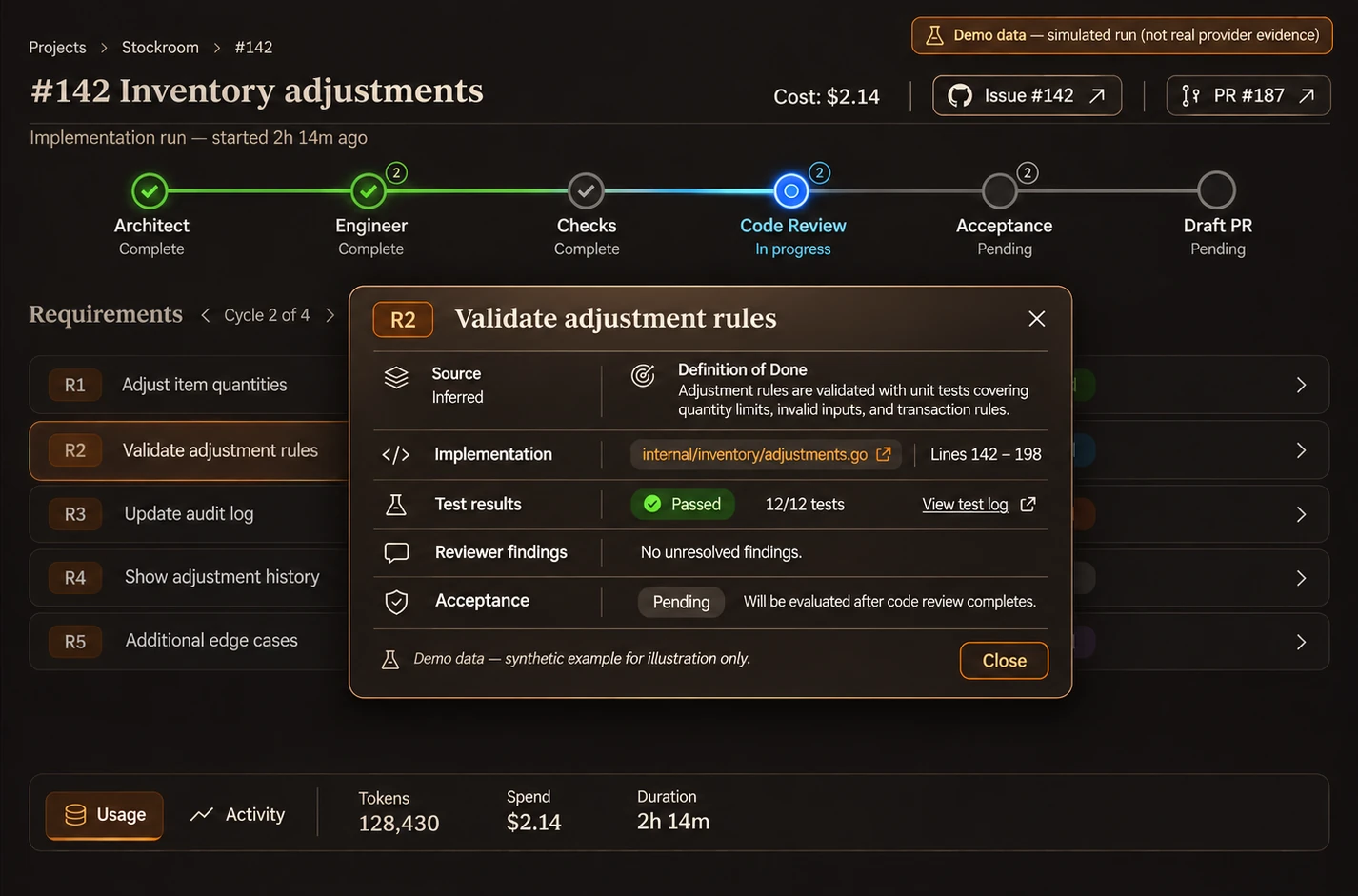
Each run follows the same stages, in order:
- Issue or intent — the starting point: what should change and why.
- Architect — turns the issue into a plan and a checklist of requirements with the evidence each one needs.
- Engineer — implements the plan and adds the tests that demonstrate it.
- Configured checks — the repository’s own commands, such as tests, vet and build, run on the candidate.
- Independent review — a separate reviewer examines the change and the assumptions behind it.
- Final acceptance — every requirement is checked against its evidence before a verdict is given.
- Draft pull request for human review — opened only after a positive acceptance verdict, with the evidence attached.
An optional QA stage can exercise the change after review. QA is off by default and is enabled per repository.
When checks, review or acceptance find a problem, the work returns to the Engineer for repair. These repair loops are bounded: after a configured number of attempts the run stops and reports what remains instead of looping indefinitely.
Pevnor’s acceptance verdict is an internal gate that comes before the draft pull request. It is not approval. People review, approve and merge the pull request, and people deploy. Your continuous integration (CI) pipeline runs separately from Pevnor’s configured checks and remains your own.
Development preview — representative/synthetic data; Hub integration in progress.
About and development status
Pevnor is an engineering-accountability product. It is in development and has no public release yet.
- Actively developing Pevnor for Linux and Windows; macOS planned next.
- The first public download will follow Hub completion and validation.